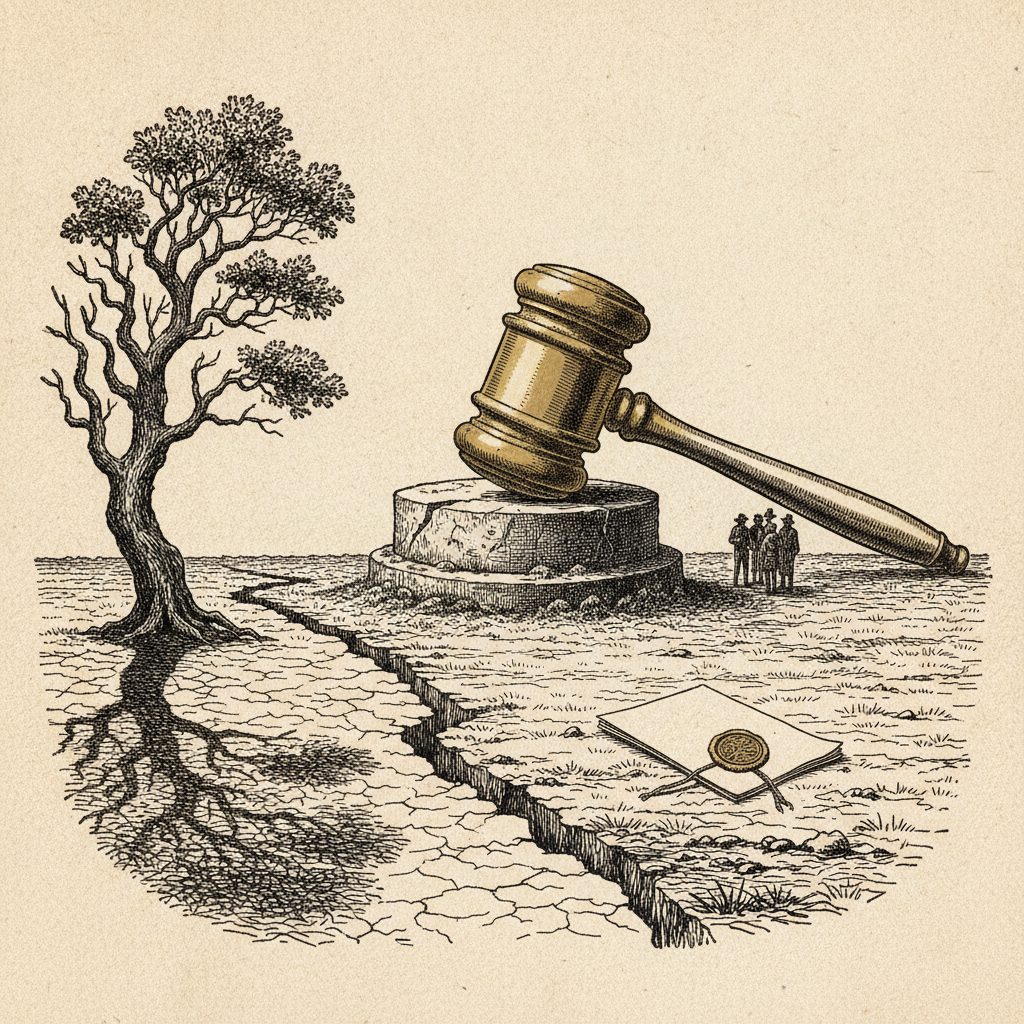
It took the Supreme Court one order list to end the age question for the Term, and most of the work was done by silence. On June 30 the Court denied certiorari in all five of the age cases pending before it. Order List, 609 U.S. ___ (June 30, 2026). They were NRA v. Glass, the challenge to Florida’s under-21 purchase ban and the vehicle from the en banc Eleventh Circuit’s Bondi decision; Bivens v. Second Amendment Foundation, the vehicle from the Third Circuit’s Lara decision; McCoy v. ATF; Picon v. United States; and WVCDL v. ATF. Five petitions asking, in five postures, whether 18-to-20-year-olds are among “the people” the Second Amendment protects. Five denials.
Four of them are unmarked. The fifth, WVCDL, carries a single sentence. “Justice Thomas would grant the petition for a writ of certiorari.” No statement, no explanation. It was a bare notation, and the only ink the age question drew from any chambers. For a Court whose preferred Second Amendment method, as I argued last week, speaks mostly where the record is empty, silence was a fitting answer.
The same order list was not idle. It granted certiorari in Viramontes v. Cook County and Grant v. Higgins, the AR-15 ban cases, limited to the question Viramontes presented and consolidated for one hour of argument. So the Court’s docket choices for next Term are now legible in a single document. It will decide what counts as an “arm.” It will not decide who counts as “the people.” The split it left standing is the one its own test created.
The Glass denial deserves its own paragraph, because it carries a distinctly Florida flavor. In August 2025, the Attorney General’s office filed a response urging the Court to take the case and strike down Florida’s own statute. Florida asked the Supreme Court to rule against Florida; the Court declined to rule at all. The purchase ban that eight federal judges upheld, the Parkland statute, stands exactly where the Eleventh Circuit left it, now with the Supreme Court’s declination stamped alongside.
Eleven days before the order list, this blog published The Gift Economy, describing the seam that Eubanks and Bondi had cut through Florida law, in which a nineteen-year-old has a confirmed constitutional right to carry a concealed handgun and no lawful market in which to buy one. That piece declined to predict what the Court would do with the petitions on its doorstep, and said only that whatever it did would be its first word on whether it wanted the question. The word came June 30. It was no, five times, in five captions, without a sentence of reasoning beyond the one notation quoted above.
Which means the seam is no longer a fresh cut awaiting a referee. It is the settled landscape, for at least another Term and as long past that as the Court’s patience holds. Carry law and purchase law for this cohort will continue to be made where they have been made all along, circuit by circuit, district by district, characterization by characterization, with no national answer to the threshold question that divides them. The Court watched this exact split ripen, was handed five separate invitations to resolve it, and spent its grants elsewhere.
So the ground truth from last month’s piece survives its first trip to Washington intact. The nineteen-year-old in Broward County may still carry what she still cannot buy. Her handgun still arrives, if it arrives, by gift, loan, or inheritance. The only thing that changed on June 30 is that this arrangement now carries the highest form of blessing our system offers short of a holding. The Supreme Court of the United States looked directly at it, five times, and declined to say otherwise.
The authorities: Order List, 609 U.S. ___ (June 30, 2026); NRA v. Bondi, 133 F.4th 1108 (11th Cir. 2025) (en banc); Eubanks v. State, No. 4D2025-1698 (Fla. 4th DCA June 17, 2026). The Thomas notation is quoted verbatim from the June 30, 2026 order list, read in full.
John J. Lloyd is a Florida attorney and the creator of the FLexlaw legal research platform.