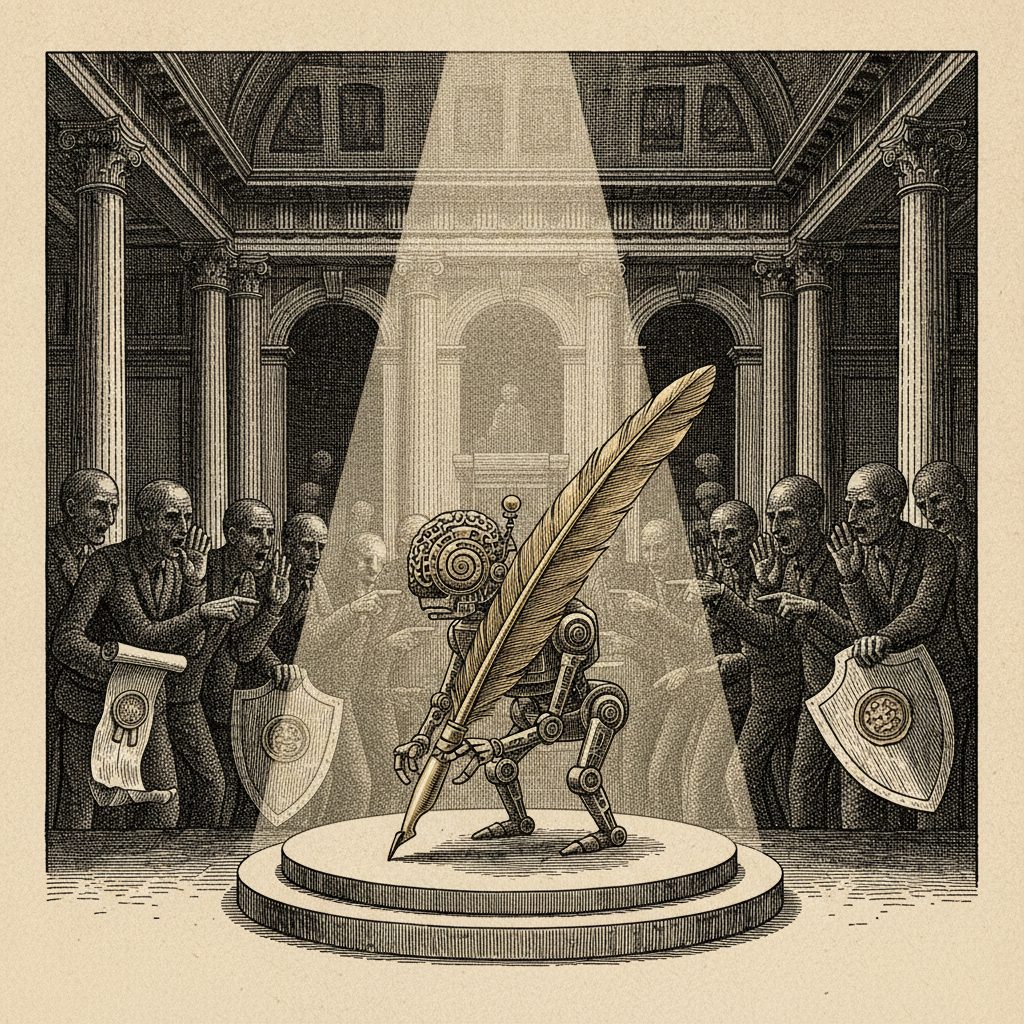
An appellate opinion does not ordinarily open with a poem. Gouveia v. Meridian Financial Investments, LLC, No. 4D2025-0843, 2026 FL 2938 (Fla. 4th DCA Mar. 25, 2026) was, on the merits, unremarkable. It affirmed a trial court order enforcing a settlement agreement in a contract dispute out of Palm Beach County. The court applied de novo review, agreed with the appellee, and affirmed without elaboration. See Sakowitz v. Waterside Townhomes Cmty. Ass’n, Inc., 338 So. 3d 26, 28 (Fla. 3d DCA 2022). The opinion spent most of its length on something else entirely, the pro se defendant’s apparent use of a large language model to draft his appellate briefs. And it opened with a limerick.
There once was a litigant pro se, / Who let an AI lead the way. / It briefed every claim, / Cited cases — by name, / That vanished by morning’s next day.
The attribution reads, “Limerick on Pro Se Parties Using Artificial Intelligence (on file with the Fourth District Court of Appeal) (generated by ChatGPT 5.2).” The humor was deliberate. The message was not.
What the court found
The defendant’s briefs were, in the majority’s words, “replete with case citations that either do not exist or fail to support the defendant’s arguments.” The opinion, authored by Judge May (Conner and Lott, JJ., concurring), cataloged the damage.
One cited case, Dausch v. Crane, 448 So. 2d 613 (Fla. 4th DCA 1984), does not exist. A citation to Bennett v. NationsBank, 759 So. 2d 1215 (Fla. 5th DCA 2000), leads instead to Summers ex rel. Dawson v. St. Andrew’s Episcopal Sch., Inc., 759 So. 2d 1203, 1206 (Miss. 2000), a Mississippi punitive damages case with no connection to the contract issues at bar. Other cited cases existed but addressed indivisible injury apportionment, summary judgment standards, section 57.105 fees, certiorari review of site plans, and Civil Service Board proceedings. None had anything to do with settlement agreement enforcement.
The court had authority ready for the occasion. It cited its own recent decision in Goya v. Hayashida, 418 So. 3d 652, 655–56 (Fla. 4th DCA 2025), for the principle that submitting fake opinions is “an abuse of the adversary system,” and noted the Third DCA’s order in Takefman v. Pickleball Club, LLC, 418 So. 3d 826, 827 (Fla. 3d DCA 2025), where a pro se appellant was ordered to show cause for using fabricated citations.
The majority put the defendant on notice that future unchecked AI use may result in sanctions for failure to comply with Florida Rule of Appellate Procedure 9.210(c).
Judge Lott’s concurrence
Judge Lott concurred in full but wrote separately, and his concurrence is the part of the opinion practitioners should read twice. His premise is that the existing remedial toolbox (sanctions, warnings, published opinions) works well enough for attorneys. Attorneys are repeat players. They are generally solvent. Sanction them and they learn; if they don’t, the Bar handles it.
Pro se litigants are a different problem, and Lott gave three reasons why. First, after-the-fact warnings do nothing to prevent new pro se litigants, who never received prior warnings, from submitting AI-generated briefing in the first place. Second, the volume is enormous. Lott declined to collect authority on the point, noting only that “it is ample” and that “[a]ny judge on any bench right now understands the pervasiveness of the problem.” Most of it, he wrote, is dealt with in unpublished orders or simply by the litigant losing without comment. Third (and this is the sharpest observation in the opinion), LLM output is uniquely resource-draining. It sounds right. It takes more effort to debunk than a traditional pro se submission, because the court and opposing counsel must explain why something that sounds plausible is wrong. And because generation is cheap, pro se litigants can produce a lot of it.
So Lott’s prescription is prophylactic, not remedial. He endorsed mandatory AI-disclosure and accuracy-certification requirements, pointing to the 11th and 17th Judicial Circuits’ recently issued administrative orders as “probably the right starting point,” and he would support adoption of a comparable requirement at the Fourth DCA.
Florida’s emerging patchwork
Gouveia does not exist in a vacuum. At least four Florida judicial circuits now have AI-disclosure administrative orders on the books. There is also a single-judge standing order in a fifth, and the pace is accelerating.
The 14th Judicial Circuit (Bay County) went first. Chief Judge Christopher N. Patterson signed Administrative Order 2025-00-09, “Responsible Use of AI Generated Technologies,” on September 16, 2025, requiring disclosure on the face of the document and a certification of personal review and accuracy verification. The order supplies sample certification language and limits sanctions to “document exclusion and other appropriate sanctions, as permitted by law.” It also mandates creation of an AI Governance Workgroup and includes a bias-monitoring obligation. Neither feature appears in the later orders. The 19th Judicial Circuit (St. Lucie County) followed in December 2025 with Administrative Order 2025-10.
In January 2026, the two largest circuits moved. The 11th Judicial Circuit (Miami-Dade) issued Administrative Order No. 26-04 on January 15, requiring disclosure and a specific certification that “all factual assertions, legal authority, and citations have been independently reviewed and verified for accuracy.” Sanctions include striking, denial of relief, monetary sanctions, contempt, and Bar referral. The 17th Judicial Circuit (Broward) issued Administrative Order 2026-03-Gen on January 26 and went further in two respects. It requires identifying the specific AI tool used by name, and it sweeps in “paraphrased assertions” and “legal analysis” as separate categories requiring independent verification. A single-judge standing order from the 6th Judicial Circuit (Pinellas County, Judge Burgess, Family Division) appeared on January 20, 2026, requiring both an AI-use disclosure and a no-use statement if AI was not involved.
At the appellate level there is no formal administrative order. The Fourth DCA’s Gouveia and Goya, together with the Third DCA’s Takefman, are doing the work through published opinions and sanctions warnings under Rule 9.210(c). No statewide uniform rule exists. Multiple commentators have called for one.
The map also has a hole in it. For practitioners in northeast Florida (St. Johns, Volusia, Flagler, and Putnam counties), there is no AI-disclosure administrative order from the 7th Judicial Circuit. That does not mean the obligations are absent. Florida Bar Ethics Opinion 24-1 (Jan. 19, 2024) confirmed that AI use is permissible but subject to Rules 4-1.1 (Competence), 4-1.6 (Confidentiality), 4-3.3 (Candor to the Tribunal), and 4-5.3 (Nonlawyer Assistance), among others. And the Florida Supreme Court’s amendments to the comments to Rules 4-1.1, 4-1.6, 4-5.1, and 4-5.3, adopted in In re Amendments to Rules Regulating the Florida Bar — Chapter 4, 393 So. 3d 137 (Fla. 2024) (SC2024-0032), added express warnings about AI use. Those obligations apply everywhere in Florida, administrative order or not. The trend line is clear. The 7th Circuit will likely follow.
Practical takeaways
For attorneys using AI in litigation (and many are, whether for research, drafting, or document review), Gouveia reinforces what should already be standard practice.
Verify every citation. Not spot-check. Verify. Pull the case. Read the parenthetical against the actual holding. Confirm the reporter citation resolves to the case you think it does. Gouveia demonstrated exactly how hallucinated citations fail. A facially plausible Southern Reporter citation resolves to a Mississippi case on punitive damages, not a Florida contract case.
If you practice in a circuit with a disclosure order (currently the 11th, 14th, 17th, or 19th), comply with the certification requirement on the face of every filing where AI was used. In Broward, name the tool. If you practice in a circuit without one, consider including the certification anyway. The 11th Circuit’s language is clean and brief. Including it costs nothing and insulates against future scrutiny.
If you are filing in the Fourth DCA, Gouveia is now on the books. The court has said what it will do. Believe it.
The full text of Gouveia v. Meridian Financial Investments, LLC, No. 4D2025-0843, 2026 FL 2938 (Fla. 4th DCA Mar. 25, 2026) is available on FLexlaw.