America at 250 · Essay One · A series reading the Revolution through its own words
On January 10, 1776, the Philadelphia printer Robert Bell published a slim pamphlet titled Common Sense. The title page did not name Thomas Paine, who had been in America barely fourteen months; early printings attributed the work only to “an Englishman,” though accounts differ on whether that line appeared on the first title page or was added by Bell to a later one. In the same news cycle, Philadelphians were absorbing the text of George III’s speech opening Parliament the previous October, the speech declaring the colonies in open rebellion and promising force to suppress it. The timing did Paine’s work for him. The King had told Americans what they were. Paine told them what they could become.
This series proposes to read the Revolution through its own words, and there is no better text to begin with. Common Sense is the hinge between grievance and independence. Six months before the Declaration, it said aloud what the Continental Congress was still afraid to whisper, and it did so in a voice no political writing in English had quite used before.
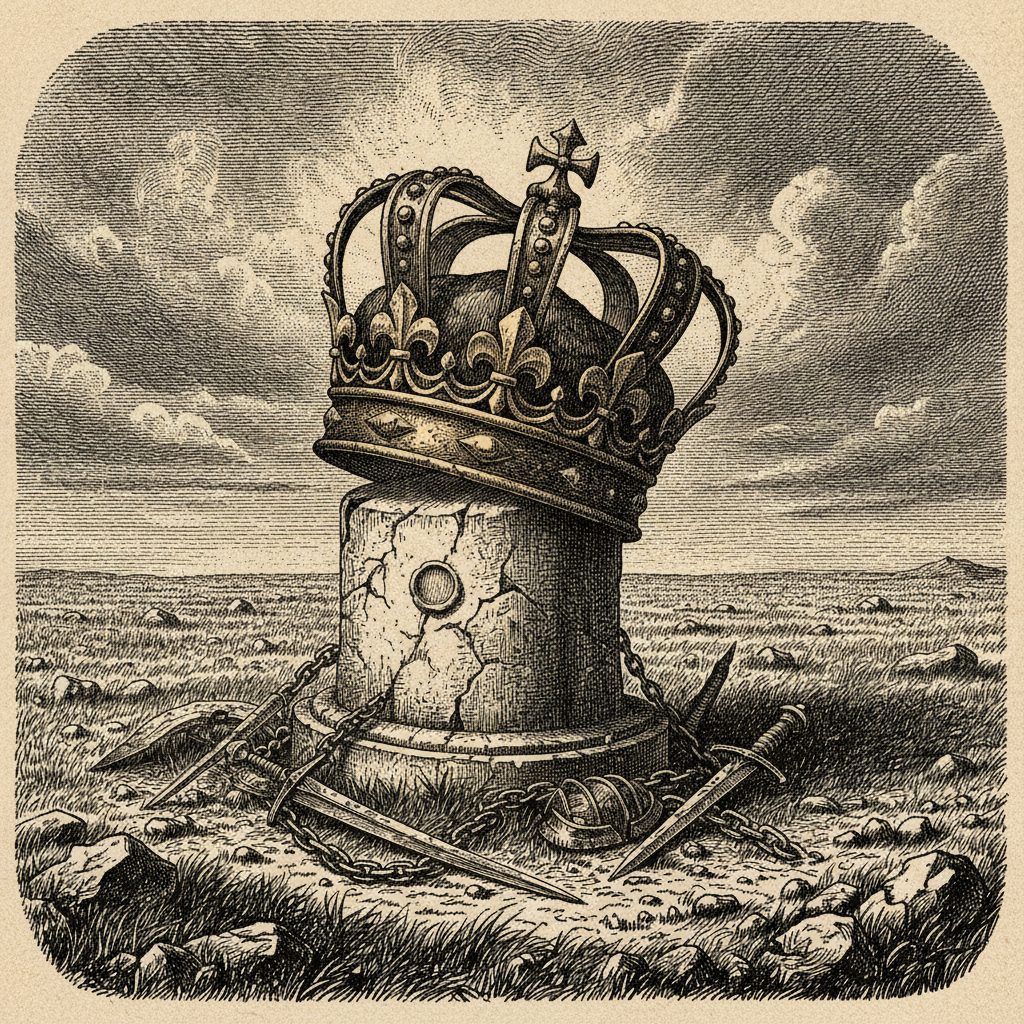
Paine opens by warning his readers that habit is not argument. In his words, “a long habit of not thinking a thing wrong, gives it a superficial appearance of being right, and raises at first a formidable outcry in defense of custom. But the tumult soon subsides. Time makes more converts than reason.” That single sentence is the pamphlet’s method. Everything that follows is an assault on custom, on the unexamined assumption that monarchy is natural, that Britain is a parent, that reconciliation is the moderate course.
What the text says
The argument moves in four steps. First, Paine separates society from government. “Society in every state is a blessing, but government even in its best state is but a necessary evil; in its worst state an intolerable one.” Society arises from our wants; government from our wickedness. This is not anarchism (Paine concedes government is necessary), but it strips the state of any sacred character before a king is ever mentioned. The reader is prepared to judge government as a tool, not revere it as an inheritance.
Second, he demolishes monarchy and hereditary succession, and he does it by ridicule rather than treatise. “One of the strongest natural proofs of the folly of hereditary right in kings, is, that nature disapproves it, otherwise she would not so frequently turn it into ridicule by giving mankind an ass for a lion.” William the Conqueror, the fountain of English royal legitimacy, becomes “a French bastard landing with an armed banditti, and establishing himself king of England against the consent of the natives … in plain terms a very paltry rascally original.” Then comes the leveling sentence. “Of more worth is one honest man to society and in the sight of God, than all the crowned ruffians that ever lived.”
Third comes the case for separation, opening with the most famous statement of method in American letters, “In the following pages I offer nothing more than simple facts, plain arguments, and common sense.” The arguments are practical (commerce, distance, the absurdity of an island governing a continent), but the register keeps rising toward something scriptural. “Every thing that is right or natural pleads for separation. The blood of the slain, the weeping voice of nature cries, ‘Tis time to part.”
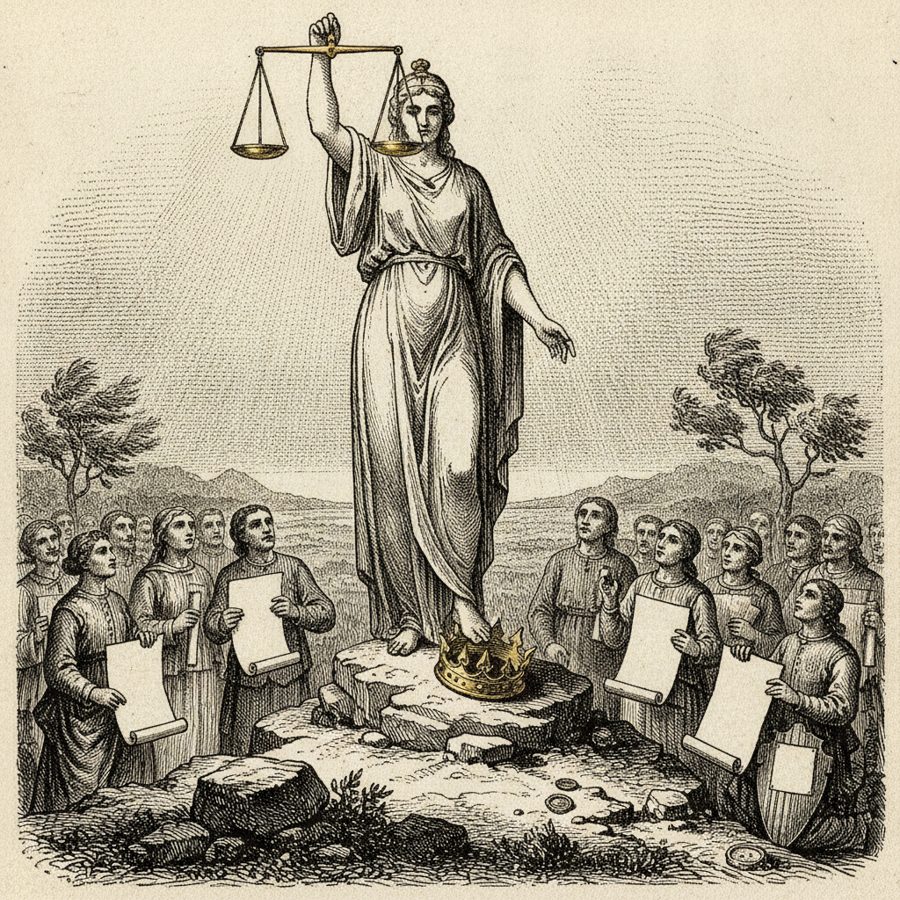
Fourth, and least remembered, Paine sketches what should replace the king. His answer is the one a lawyer at the 250th should linger on. Asked where the King of America is, Paine answers that he “reigns above, and doth not make havoc of mankind like the Royal Brute of Britain.” Then, in a ceremony he invents on the page (a crown placed upon the divine law and the charter), he draws the moral that “so far as we approve of monarchy … in America the law is king. For as in absolute governments the King is law, so in free countries the law ought to be King; and there ought to be no other.”
Two more sentences complete the pamphlet’s self-understanding. One gives America a mission to the world. “Freedom hath been hunted round the globe. Asia, and Africa, have long expelled her — Europe regards her like a stranger, and England hath given her warning to depart. O! receive the fugitive, and prepare in time an asylum for mankind.” The other, from the Appendix, gives the Revolution its tense, which is future, not past. “We have it in our power to begin the world over again. … The birthday of a new world is at hand.”
What it meant then
Paine claimed enormous sales; figures of 100,000 to 150,000 copies circulated, most of them traceable to Paine himself. Modern scholarship treats those numbers skeptically. Trish Loughran, examining the actual print runs, puts the outer limit near 75,000 and suspects the real figure was substantially lower. The honest statement is that we do not know how many copies sold. We know only that the pamphlet was reprinted up and down the seaboard within weeks, and that contemporaries on both sides treated it as an event. The inflation is itself part of the history. Common Sense was the first American text to generate its own myth of ubiquity, the eighteenth-century ancestor of the claim to have gone viral.
The reactions tell us what the text actually did. John Adams wanted independence as much as Paine did, and he admired the pamphlet’s “manly” case for separation. What alarmed him was the constitutional sketch, with its single legislature and no balancing branches. “His plan was so democratical, without any restraint or even an Attempt at any Equilibrium or Counterpoise, that it must produce confusion and every Evil Work,” Adams wrote in his autobiography. He answered with Thoughts on Government that same spring, proposing bicameralism, an independent judiciary, and separated powers. The first great American constitutional debate, in other words, was not between patriot and loyalist. It was between two readers of Common Sense, the man who wrote it and the man who feared what it left out. The Constitution of 1787 is, in no small part, Adams’s side of that argument made law. Its preamble’s “We the People” is Paine’s.
Through history
Paine himself fell out of the story he started. The Age of Reason made him a byword for infidelity, and he died in New York in 1809 nearly unmourned. The pamphlet outlived the man’s reputation, and its afterlife has been strikingly bipartisan. Lincoln’s generation absorbed its leveling logic into the antislavery argument. And in July 1980, accepting the Republican nomination, Ronald Reagan reached past two centuries of conservative suspicion of Paine to quote the Appendix directly. “We have it in our power to begin the world over again.” George Will protested that it was “the least conservative sentiment conceivable.” He was right, and that is the point. The line belongs to no party because it states the American premise itself. Political arrangements are made, not inherited, and can be remade.
Now
Read at 250, the pamphlet presses three questions on us.
The first, the one Paine put in capital relief, is whether the law is still king. His formulation is the plainest statement of the rule of law in our founding literature. It says not that America has law, but that law occupies the throne, and “there ought to be no other.” Every modern argument about executive power, about officials bound by court orders, about whether any office places its holder above legal process, is an argument about whether Paine’s coronation scene still describes us.
The second is the “asylum for mankind.” Paine made openness to the world’s fugitives a constitutive feature of the country, not a policy choice but part of the founding self-description. Whatever position one takes in the immigration debates of the 2020s, it is worth knowing that the text that first argued America into existence defined her, in the same breath, as a refuge.
The third is the hardest, because it is the one Adams posed and the text never answers. Common Sense is the founding document of American demolition, of the plain-spoken, custom-scorning voice that tells ordinary readers their own judgment outranks every institution. Abolitionists have used that voice since; so have demagogues. Paine proved that a pamphlet in the common idiom could dissolve a three-hundred-year-old loyalty in six months. He did not prove, and Adams doubted, that the same voice could build. The American experiment since 1776 has been the long test of whether a people taught to distrust inherited authority can nonetheless sustain the institutions (the “Equilibrium or Counterpoise”) that self-government requires.
“Time makes more converts than reason,” Paine wrote of the customs he meant to destroy. Two hundred fifty years on, his own pamphlet has become the custom, the inherited thing Americans no longer examine. The best way to honor it is to do what he asked of his first readers, to divest ourselves of prepossession, and to read the thing itself.
Thomas Paine, Common Sense (Philadelphia: Robert Bell, 1776). Quotations taken from the original text. Sales figures discussed in Trish Loughran, The Republic in Print: Print Culture in the Age of U.S. Nation Building, 1770–1870 (Columbia Univ. Press, 2007). Adams’s reaction is from his Autobiography, and from his Thoughts on Government (1776).