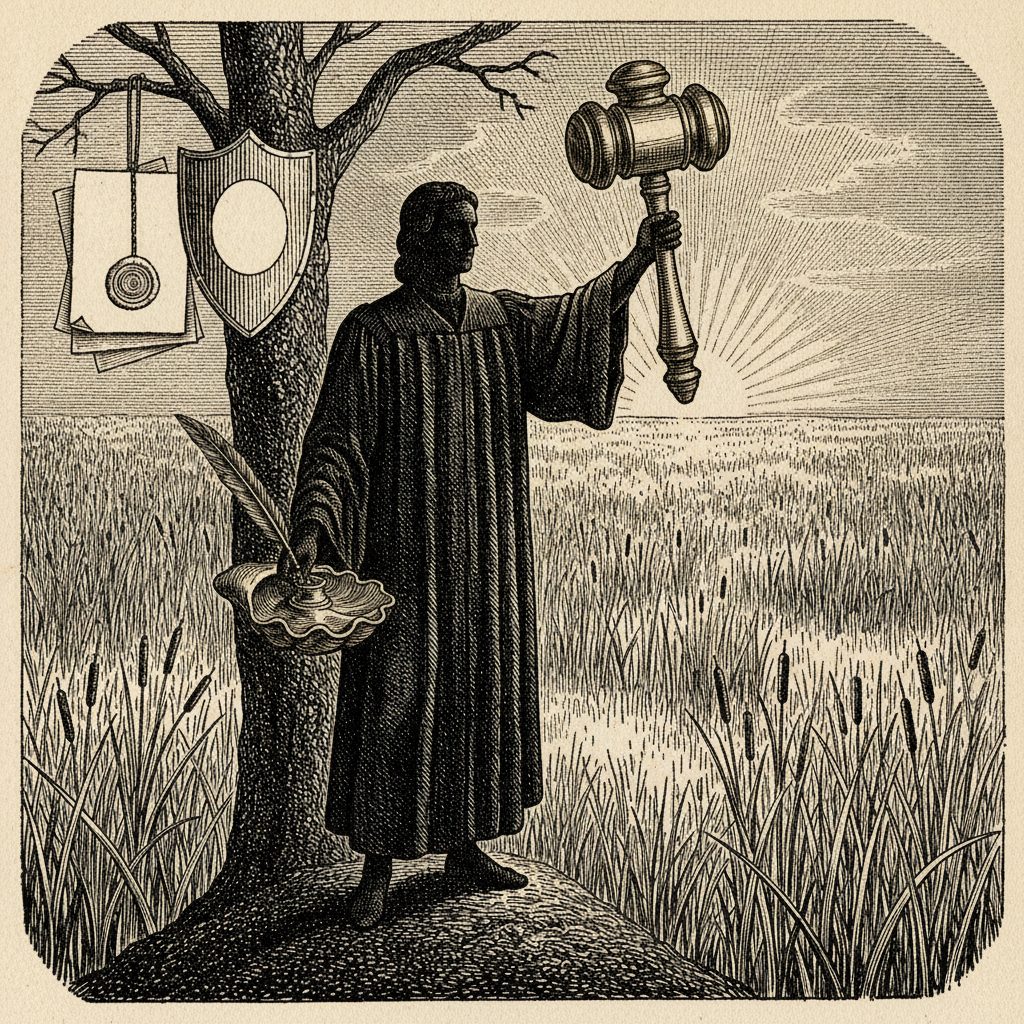
In March 2026, Judge May’s Fourth District panel paused midway through its published opinion in Gouveia v. Meridian Financial Investments, LLC (under the heading “AI Spotted”) for a limerick.
There once was a litigant pro se, / Who let an AI lead the way. / It briefed every claim, / Cited cases — by name, / That vanished by morning’s next day.1
The limerick itself was “generated by ChatGPT 5.2” and placed “on file” with the court.2 The panel had already affirmed the trial court’s enforcement of a settlement agreement; it then set about documenting, by name, the “non-existent cases” the defendant had cited. Among them were Dausch v. Crane, 448 So. 2d 613 (the panel could not find it) and Bennett v. NationsBank, 759 So. 2d 1215 (the citation actually pointed to a Mississippi tort decision on punitive damages).3 The briefs, the panel concluded, “were replete with case citations that either do not exist or fail to support the defendant’s arguments.”4
Gouveia was neither the first nor the last such opinion in a very busy twelve months. It may be the funniest. But when Florida’s courts have addressed the ethical use of generative artificial intelligence in lawyering, they have said, with rare unanimity, what the Sixth District said a few weeks later in slightly different words. The duty is the same, with or without the machine.
The rules that started the run
The Florida Supreme Court teed up the current moment in August 2024. In In re Amendments to Rules Regulating The Florida Bar — Chapter 4, 393 So. 3d 137 (Fla. 2024), the Court amended the Comments to Rules 4-1.1 (competence), 4-1.6 (confidentiality), 4-5.1 (responsibilities of partners), and 4-5.3 (responsibilities regarding nonlawyer assistants) to add “a warning about the necessity to take care in using generative artificial intelligence.”5 The amendments took effect October 28, 2024. They sit on top of, not instead of, the competence, candor, and supervision obligations that have always applied.
Florida Bar Ethics Opinion 24-1 (Jan. 19, 2024) had landed seven months earlier and remains the principal advisory authority Florida courts cite when they explain what “reasonable use” of generative AI looks like in practice.6 Opinion 24-1 is not binding law. It is, however, cited in nearly every 2025–2026 administrative order that followed.
The circuit orders
Beginning in early 2025, Florida’s trial circuits started issuing AI-specific administrative orders at a pace that, in retrospect, tracks the federal and appellate sanctions docket quite closely. The pattern is consistent. It pairs disclosure on the face of any filing that contains AI-generated content with a signed certification that the filer has “personally reviewed and verified” the accuracy of that content.
The Fourteenth Judicial Circuit was early. Administrative Order 2025-00-09 (eff. Jan. 1, 2025) requires “any attorney or pro se litigant who submits to the court any filing or submission containing AI-generated content” to disclose that use on the face of the document and to certify personal review and verification.7 The Fifth took a different route to the same place, embedding a “Warning as to Generative Artificial Intelligence” paragraph in its differentiated-civil case management orders across several counties and divisions beginning January 1, 2025. The paragraph states that “[a]n attorney may ethically utilize Generative Artificial Intelligence technologies but only to the extent that the lawyer can reasonably guarantee compliance with the lawyer’s ethical obligations,” then cites Fla. Bar Ethics Op. 24-1 and Rules 4-1.1, 4-1.6, 4-5.1, and 4-5.3.8
The Seventeenth Judicial Circuit (Broward) issued Administrative Order 2024-26-Civ Amendment 2 (Apr. 9, 2025), consolidated into AO 2025-24-Civ (eff. Jul. 24, 2025), requiring disclosure and certification of AI-generated content in any filing,9 then returned in January 2026 with AO 2026-03-GEN (Amendment 1) to formalize its disclosure regime circuit-wide.10 The Eleventh (Miami-Dade) issued Administrative Order 26-04 (eff. Jan. 15, 2026), which recites that “attorneys and self-represented litigants increasingly use generative artificial intelligence (‘AI’) tools . . . and such tools may generate inaccurate, misleading, or entirely fabricated factual assertions or legal authority.”11 On the same day, the Eleventh adopted an internal order, “Prohibition on Use of Non-Approved Generative Artificial Intelligence Platforms by Court Personnel,” flagging data-security, confidentiality, and retention gaps in publicly available AI platforms.12
The Seventh Judicial Circuit (Chief Judge Leah R. Case) issued a standalone Artificial Intelligence Administrative Order (doc. no. G-2026-045-SC and related re-postings through February 26, 2026), warning that “those who file court documents must be aware that AI-generated information may be incorrect and must therefore take steps to verify the accuracy of all information contained in filings.”13 The Eighteenth (Seminole and Brevard) followed on January 1, 2026 with AO 26-10, “Disclosure of Generative AI Use by Attorneys and Self-Represented Litigants,” grounding its authority in the Supreme Court’s 2024 Chapter 4 amendments.14 The Nineteenth posted AO 2025-10, “Use of Artificial Intelligence in Court Filings,” effective December 22, 2025.15 And the Eighth, addressing the other side of the practice, issued Policy 10.07, restricting court personnel from processing sealed case information, CJI, or internal deliberations through AI tools absent specific authorization.16
A fair summary is that by early 2026, a practitioner in Florida can no longer safely assume that her local circuit has no rule on this. Many do.
The appellate wave
Florida’s District Courts of Appeal began issuing published AI-ethics opinions in late 2024 and have not stopped. Gutierrez v. Gutierrez, 399 So. 3d 1185, 1188 (Fla. 3d DCA 2024), decided December 4, 2024, is usually credited as the first Florida DCA opinion to sanction a litigant for citing fictitious case law in a pattern consistent with AI hallucination. The court dismissed the consolidated pro se appeals as a sanction and barred future pro se filings in the probate action absent review by a member of The Florida Bar.17
Then came the 2025 run. Takefman v. Pickleball Club, LLC, 418 So. 3d 826, 827 (Fla. 3d DCA 2025), addressed “an issue of growing concern—the proliferation” of AI-generated phantom citations in pro se briefs.18 Goya v. Hayashida, 418 So. 3d 652, 655–56 (Fla. 4th DCA 2025), crystallized the harms. “An attempt to persuade a court or oppose an adversary by relying on fake opinions is an abuse of the adversary system. . . . Many harms flow from the submission of fake opinions . . . wasting the opposing party’s time and money . . . taking the court’s time from other important endeavors, and potential harm to the reputation of judges and courts whose names are falsely invoked.”19 Friend v. Serpa, 425 So. 3d 51, 51 (Fla. 4th DCA 2025), gave us the sentence the Fourth District now repeats like a mantra, “Those who use artificial intelligence to assist in these submissions must ensure their accuracy.”20 Russell v. Mells, 50 Fla. L. Weekly D2609 (Fla. 2d DCA Dec. 10, 2025), referred counsel to The Florida Bar, explaining that “[w]hen a lawyer cites imaginary legal authorities to our court as if they were law, we are compelled to refer that lawyer to the Bar.”21 And Clerk of Ct. & Comptroller for the 13th Jud. Cir., Hillsborough Cnty. v. Rangel, No. 2D2024-1772, 2025 WL 2486314, at *2 (Fla. 2d DCA Aug. 29, 2025), warned that “the dangers of relying on generative artificial intelligence have been discussed in the media, in legal publications, and in court opinions.”22
The first quarter of 2026 brought a wave. Straub v. Henderson (2d DCA, Feb. 25, 2026) affirmed per curiam while citing Rangel and Takefman side by side.23 Roussell v. Bank of New York Mellon (4th DCA, Mar. 11, 2026) recorded what may be the current Florida record, noting that “[t]he appellant cited thirteen different cases that do not exist,” along with nine additional real-but-misdescribed authorities.24 Francois v. Vive Financial, LLC (4th DCA, Mar. 18, 2026) closed with a line that reads like a motto for the whole line of cases. “Artificial intelligence may assist in research and drafting, but it cannot replace the lawyer’s or litigant’s duty to ensure that every authority cited is real, accurate, and applicable. The responsibility for what is filed rests with the human author, not the machine.”25
Gouveia v. Meridian Financial Investments, LLC (4th DCA, Mar. 25, 2026), our limerick case, added a concurrence from Judge Lott that is worth reading in full.26 Judge Lott distinguishes the attorney problem from the pro se problem. For attorneys, he writes, the existing toolbox works. “Sanction them, and they will learn from it. Monetary sanctions imposed on attorneys, who tend to be solvent, can make their adversaries whole for the time wasted by misconduct.” The pro se problem is harder. Pro se litigants are not repeat players, “the cost to generate the content is so low, they can put in a lot of it,” and “AI Chatbots . . . do not ‘think.’ They make predictions about what words ought to come next.” He endorses prospective AI-disclosure rules like those adopted by the Eleventh and Seventeenth Circuits.
Which brings us to the Sixth District. Hessert v. Hessert, No. 6D2026-0121, 2026 WL 785016 (Fla. 6th DCA Mar. 20, 2026), is that court’s foundational statement. Rodriguez v. Rodriguez, No. 6D2025-3086 (Fla. 6th DCA Apr. 10, 2026), is the follow-up, and it matters because it extends Hessert’s framework, originally articulated in a pro se context, to a member of The Florida Bar who signed the offending petition.27 In Rodriguez, the Sixth District issued an order to show cause directing attorney Karin S. Gerardin to (1) produce copies of each actually-existing case cited in the petition and reply, indexed and with highlighted quotations supporting the assertions made in the briefs; (2) explain why she should not be sanctioned; and (3) explain why she should not be referred to The Florida Bar for discipline. The court quoted the foundational Hessert passage. Then it said the magic words, “We . . . adopt and incorporate the reasoning of Hessert in full in this opinion.”
The federal echo
Florida’s federal district courts have been at least as active. What follows is a representative sample, not an exhaustive one. Hayes v. Chipotle Mexican Grill, LLC (M.D. Fla., Jan. 9, 2026) invoked the “inherent authority to sanction the misuse of AI when it affects the Court’s docket, case disposition, and ruling.”28 Hylton v. Hylton (S.D. Fla., Jan. 5, 2026), a magistrate judge’s report and recommendation, warned that Rule 11(b)’s “reasonable inquiry” requirement is not satisfied by “[r]elying on artificial intelligence to generate cases to support a proposition . . . without verifying the existence of an actual case.”29 The Doc App, Inc. v. Leafwell, Inc. (M.D. Fla., Dec. 29, 2025) imposed on counsel, among other sanctions, the requirement to “attend an in-person CLE program in Florida on legal ethics and artificial intelligence” and referred him to The Florida Bar.30 Bey v. Glass (M.D. Fla., Dec. 1, 2025) held a citation to a non-existent “Ford v. Browning” to be “a hallucination, possibly caused by the use of Artificial Intelligence during the drafting of the Complaint,” and warned of Rule 11 sanctions.31
Rollins v. Premier Motorcars Inc. (N.D. Fla.) generated two consecutive orders in July 2025. The first observed that plaintiff’s citations “have the hallmarks of cases generated by AI found in other courts” (quoting Sanders v. United States, 176 Fed. Cl. 163, 169 (2025)). Two weeks later, the court noted that plaintiff’s promise to “avoid reliance on AI for legal authorities unless independently verified” had already broken down. The next amended complaint “again include[d] a nonexistent case.”32 Sheets v. Presseller (M.D. Fla., Mar. 11, 2025) and Huntington Bank v. M/Y Something About Meri (S.D. Fla., Jun. 11, 2025) round out the picture with allegations of AI-generated content (in discovery correspondence and in harassment filings, respectively), each drawing a judicial warning.33
What Rodriguez actually held
If a single thesis can be extracted from this entire body of law, Rodriguez v. Rodriguez states it plainly. Quoting Hessert and adopting it in full, the Sixth District held:
Although AI is a relatively new technology, and although AI may have appropriate uses in the legal field, there is simply no excuse for pro se litigants or attorneys to file briefs, motions, and other filings in Florida’s appellate courts that cite to cases without first performing the necessary and simple steps of (1) cite-checking the cases to ensure they actually exist and (2) cite-checking the cases to ensure they actually represent the legal propositions asserted. . . . This is true regardless of whether such filings are prepared with or without the assistance of AI.34
And:
[P]ro se litigants and attorneys should . . . remember their obligation to cite-check all cases cited in their filings in Florida’s appellate courts prior to making their filings—regardless of whether their filings are prepared with or without the assistance of AI. . . . [They] cannot satisfy their aforementioned obligation by relying upon AI to cite-check the cases cited in their filings.
(Emphasis added.)
That last sentence is the one to underline. The court is not saying AI is forbidden. It is not even saying AI is uniquely dangerous. It is saying that the duty to verify every authority in a filed brief is old and constant. It cannot be outsourced to opposing counsel or to junior associates, and certainly not to a chatbot.
The authorities the Sixth District marshals to reach that conclusion are not new. They are Fla. R. App. P. 9.045(d), which requires filings to be signed; Fla. R. Gen. Prac. & Jud. Admin. 2.515(d)(2), under which the signature represents that “the signer has read the document” and that “to the best of the signer’s knowledge, information, and belief, there are good grounds to support the document”; R. Regulating Fla. Bar 4-1.1 (competence); 4-1.3 (diligence); 4-3.3(a)(1) (candor to the tribunal); and Boca Burger, Inc. v. Forum, 912 So. 2d 561, 571 (Fla. 2005), which holds that “regardless of trial counsel’s conduct or representations, appellate counsel . . . has an independent ethical obligation to present both the facts and the applicable law accurately and forthrightly.”35 None of these rules or decisions was written with ChatGPT in mind. All of them dispose of the problem without needing to be.
What has actually changed
Three things, in this author’s estimation.
First, the volume and velocity of bad citations. Generative-AI tools have lowered the marginal cost of producing a confident-sounding brief to approximately zero. Judge Lott’s concurrence in Gouveia captures the mechanism well. Pro se litigants, “lacking legal training, do not appreciate how or why a response might not be right. But it sounds right, so they put it in their brief to see what happens.” The old rules always prohibited phantom citations. The new tools make it vastly easier to generate them.
Second, Florida’s trial courts have layered a procedural requirement on top of the existing ethical one. The 11th, 14th, 17th, 18th, and 19th Circuits now require an affirmative certification on the face of AI-assisted filings, and the 5th Circuit builds a Rule-4-based warning into its standard CMOs. Practitioners who move between circuits need to check local practice, not because the ethical duty differs (it does not), but because the procedural consequences of inattention now include facial noncompliance with a local administrative order.
Third, the appellate courts have demonstrated that they will actually impose sanctions. The show-cause orders in Gutierrez, Takefman, Russell, Hessert, and Rodriguez, along with the M.D. Fla.’s CLE-plus-Bar-referral order in Doc App, suggest that the period of free passes is closing. Attorneys who file AI-generated briefs without verifying their content can now expect, at a minimum, a public order to show cause, the production of indexed copies of every actually existing case with the supporting language highlighted, and a real prospect of referral to The Florida Bar.
The practical prescription is almost embarrassingly old-fashioned. Before filing, read every case you cite. Read the holding. Confirm it says what your brief says it says. If you delegated first-draft research to a generative-AI tool, treat the tool’s output as you would a competent but inexperienced summer associate’s memo, useful as a starting point, never filed verbatim, and always verified against the primary source. Check the reporter citation. If the case does not appear on Westlaw, Lexis, or the CourtListener archive, do not cite it. Know the statewide certification rule (amended Rule 2.515) and whether your circuit has layered anything on top of it. Keep a clean paper trail of your cite-check work. If a colleague or opposing counsel catches a phantom citation, confess it on the record and withdraw the brief.
None of this is new. The Supreme Court’s October 2024 Chapter-4 amendments did not add a single new duty that was not already implied by Rule 4-1.1’s competence requirement or Rule 2.515(d)’s signature warranty. They simply wrote the warning down. The DCAs and district courts have been pointing at that warning, sometimes in limericks, for the past eighteen months.
The Rodriguez court quoted Hessert, adopted it in full, and said in so many words that the duty to cite-check is the same whether the brief was drafted on a legal pad, in Microsoft Word, or by GPT-5.2. The fundamentals carry you through. They always have.
Notes
- Elilton Alves Gouveia v. Meridian Financial Investments, LLC, No. 4D2025-0843, slip op. at 2 (Fla. 4th DCA Mar. 25, 2026). The limerick is identified in the opinion as “Limerick on Pro Se Parties Using Artificial Intelligence (on file with the Fourth District Court of Appeal) (generated by ChatGPT 5.2).”
- Gouveia, slip op. at 2.
- Id. at 2–3.
- Id. at 2–3.
- In re Amendments to Rules Regulating The Florida Bar — Chapter 4, No. SC2024-0032 (Fla. Aug. 29, 2024), 393 So. 3d 137. Effective date October 28, 2024.
- Fla. Bar Ethics Op. 24-1 (Jan. 19, 2024). The 6th DCA in Rodriguez v. Rodriguez, No. 6D2025-3086, slip op. at 3 n.1 (Fla. 6th DCA Apr. 10, 2026), summarizes the opinion’s description of generative AI as “deep-learning models that compile data to generate statistically probable outputs when prompted” and warns that “generative AI can hallucinate or create inaccurate answers that sound convincing.”
- Fourteenth Judicial Circuit Administrative Order 2025-00-09 (eff. Jan. 1, 2025), available at https://jud14.flcourts.org/uploaded/media/doc/administrative_orders/2025-00-09.pdf (FLexlaw court_documents id 1084).
- Fifth Judicial Circuit Administrative Order A-2024-59 ¶ 5 (eff. Jan. 1, 2025) (FLexlaw id 1640); see also Standing Order of Judge Daly (eff. Mar. 20, 2025) (FLexlaw id 8688); Judge Scaglione Differentiated Civil CMO (eff. Jan. 16, 2025) (FLexlaw id 8700). Each contains the same “Warning as to Generative Artificial Intelligence” paragraph.
- Seventeenth Judicial Circuit AO 2025-24-Civ (Combined) (eff. Jul. 24, 2025) (FLexlaw id 9581).
- Seventeenth Judicial Circuit AO 2026-03-GEN (Amendment 1) (eff. Jan. 27, 2026) (FLexlaw id 655).
- Eleventh Judicial Circuit AO 26-04, “Disclosure of Use of Generative AI by Attorneys and Self-Represented Litigants” (eff. Jan. 15, 2026) (FLexlaw ids 4120, 10984).
- Eleventh Judicial Circuit, “Prohibition on Use of Non-Approved Generative Artificial Intelligence Platforms by Court Personnel” (eff. Jan. 15, 2026) (FLexlaw id 4119).
- Seventh Judicial Circuit Administrative Order on Artificial Intelligence, doc. no. G-2026-045-SC (eff. Jan. 1, 2026), and re-postings at Feb. 23, 24, and 26, 2026 (FLexlaw ids 4292, 9356, 9358, 9362).
- Eighteenth Judicial Circuit AO 26-10, “Disclosure of Generative AI Use by Attorneys and Self-Represented Litigants” (eff. Jan. 1, 2026) (FLexlaw id 11329).
- Nineteenth Judicial Circuit AO 2025-10, “Use of Artificial Intelligence in Court Filings” (eff. Dec. 22, 2025) (FLexlaw ids 10598, 10602).
- Eighth Judicial Circuit Policy 10.07, “Acceptable Computer Use Policies” (eff. Jan. 30, 2026) (FLexlaw id 1945).
- Gutierrez v. Gutierrez, No. 3D24-1087 (Fla. 3d DCA Dec. 4, 2024), published at 399 So. 3d 1185, 1188. FLexlaw case id 1506233. The opinion records that the appellee filed “a notice of phantom case law” and sought sanctions for “citing fictitious or non-existent case law.”
- Takefman v. Pickleball Club, LLC, 418 So. 3d 826, 827 (Fla. 3d DCA 2025). Cited in Straub v. Henderson, No. 2D2025-1787, slip op. at 1 (Fla. 2d DCA Feb. 25, 2026) (FLexlaw id 1497119); Francois v. Vive Financial, LLC, No. 4D2025-2088, slip op. at 1 (Fla. 4th DCA Mar. 18, 2026) (FLexlaw id 1525366); and Gouveia, slip op. at 3 n.2.
- Goya v. Hayashida, 418 So. 3d 652, 655–56 (Fla. 4th DCA 2025). Quoted in Gouveia, slip op. at 3, and Francois, slip op. at 1.
- Friend v. Serpa, 425 So. 3d 51, 51 (Fla. 4th DCA 2025). Quoted in Francois, slip op. at 2, and Roussell v. Bank of N.Y. Mellon, No. 4D2025-1309, slip op. at 2 (Fla. 4th DCA Mar. 11, 2026) (FLexlaw id 1511698).
- Russell v. Mells, 50 Fla. L. Weekly D2609, 2025 WL 3533637 (Fla. 2d DCA Dec. 10, 2025). Quoted at length in Hessert v. Hessert, No. 6D2026-0121, 2026 WL 785016, at *2 (Fla. 6th DCA Mar. 20, 2026) (FLexlaw id 1525501): “As judges, we rely on attorneys to ethically represent their clients. We expect that representation to be zealous, honest, and competent.”
- Clerk of Ct. & Comptroller for the 13th Jud. Cir., Hillsborough Cnty. v. Rangel, No. 2D2024-1772, 2025 WL 2486314, at *2 (Fla. 2d DCA Aug. 29, 2025).
- Straub v. Henderson, Margaret McShane Revocable Trust, No. 2D2025-1787 (Fla. 2d DCA Feb. 25, 2026) (FLexlaw id 1497119).
- Roussell v. Bank of N.Y. Mellon, No. 4D2025-1309, slip op. at 1–2 (Fla. 4th DCA Mar. 11, 2026) (FLexlaw id 1511698).
- Francois v. Vive Financial, LLC, No. 4D2025-2088, slip op. at 2 (Fla. 4th DCA Mar. 18, 2026) (FLexlaw id 1525366).
- Gouveia, slip op. at 4–6 (Lott, J., concurring).
- Rodriguez v. Rodriguez, No. 6D2025-3086, slip op. at 2–3 (Fla. 6th DCA Apr. 10, 2026) (FLexlaw case id 1528245) (quoting Hessert v. Hessert, No. 6D2026-0121, 2026 WL 785016, at *1–2 (Fla. 6th DCA Mar. 20, 2026)).
- Ryan Hayes v. Chipotle Mexican Grill, LLC, No. 8:25-cv-3286, slip op. at 4 (M.D. Fla. Jan. 9, 2026) (FLexlaw id 1414518) (quoting United States v. Stephens, 23-CIV-80043-SINGHAL, 2025 WL 2840746, at *3 (S.D. Fla. Aug. 7, 2025)).
- Ayatollah Hylton v. Chivone Janee Hylton, No. 0:25-CV-62206, slip op. at 5 (S.D. Fla. Jan. 5, 2026) (FLexlaw id 1432939).
- The Doc App, Inc. v. Leafwell, Inc., No. 2:25-cv-838 (M.D. Fla. Dec. 29, 2025) (FLexlaw id 1414632).
- Ali Taj Bey v. Mark Glass, No. 8:25-cv-01977 (M.D. Fla. Dec. 1, 2025) (FLexlaw id 1414858).
- Rollins v. Premier Motorcars Inc., No. 4:24-cv-413 (N.D. Fla. Jul. 15, 2025) (FLexlaw id 1441829), reaffirmed (N.D. Fla. Jul. 30, 2025) (FLexlaw id 1441846).
- Sheets v. Presseller, No. 2:24-CV-495 (M.D. Fla. Mar. 11, 2025) (FLexlaw id 1417420); Huntington Bank v. M/Y Something About Meri, No. 25-61018-CIV (S.D. Fla. Jun. 11, 2025) (FLexlaw id 1433712).
- Rodriguez, No. 6D2025-3086, slip op. at 2–3 (quoting Hessert, 2026 WL 785016, at *1–2).
- Hessert v. Hessert, No. 6D2026-0121, 2026 WL 785016, at *3–4 (Fla. 6th DCA Mar. 20, 2026).